
From Data Readiness to AI Anywhere: Why Australia’s AI moment hinges on trust
By Leo Brunnick (pictured), Chief Product Officer, Cloudera
At a recent AWS Summit, one theme was clear: Australia is no longer asking whether Artificial Intelligence (AI) can deliver value. The question now is whether organisations have the data foundations in place that are required to scale it. Not just in the theoretical sense, but in the reality of today’s fragmented, messy enterprise data estates.
After three decades working across enterprise technology and AI, I’ve seen several waves of transformation. What stands out in this moment is the widening gap between ambition and execution. Organisations are moving quickly on AI, but many are still constrained by data that is not consistently governed, accessible or trusted across environments.
The data readiness gap is now impossible to ignore
Australia’s AI ambition is increasingly colliding with a data readiness problem.
On the surface, AI adoption looks strong. Many organisations have already embedded AI into some core processes. But when you look closer, the underlying picture is less convincing. Nearly 8 in 10 organisations say their AI initiatives are constrained by fragmented data and limited access across environments, while only 7% believe their data is truly ready for AI at scale.
In Australia, that challenge is amplified by a more cautious and pragmatic approach to AI adoption. Organisations are actively experimenting, but with a deliberate focus on governance, trust and control. That then raises the bar for how AI is deployed and, importantly, what else is needed to deliver scale responsibly.
That gap becomes most visible when teams try to move beyond pilots. Data remains scattered across various systems, quality is inconsistent, and access is often limited. None of this is new, but AI raises the stakes. If data is not trusted or accessible, scaling simply stalls.
At a time when leaders are under pressure to show measurable returns, that gap is becoming harder to ignore.
From data silos to “AI Anywhere”
This is precisely why we’re seeing a shift in how organisations think about AI architecture.
For years, the assumption was that value comes from centralising data and moving everything onto a single platform, typically in the cloud. In practice, that approach has proven slow, complex, and difficult to reconcile with regulatory and sovereignty requirements.
The emerging data management model flips that thinking: instead of moving their data to where the AI lives, organisations are bringing their AI to where data resides.
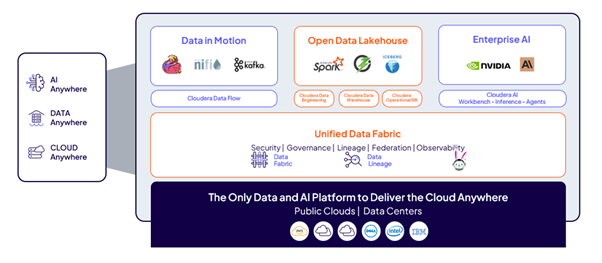
This is what we describe as an “AI Anywhere”, “Cloud Anywhere”, “Data Anywhere” approach. In simple terms, it’s about delivering flexibility by enabling organisations to run analytics and AI across hybrid, multi-cloud, and on-prem environments, without sacrificing control or compliance.
More importantly, this is as much a mindset shift as a technical one. Organisations do not need a perfect data estate to govern data well or move forward with confidence. That matters because businesses today do not have the luxury of waiting years for data modernisation programs to finish before they pursue AI outcomes.
An “AI Anywhere” approach helps organisations achieve their desired AI outcomes sooner. It allows organisations to use AI across fragmented environments, query data in place instead of copying it repeatedly, and maintain tighter control over sensitive assets. In regulated industries, especially where sovereignty requirements are non-negotiable, this model is becoming essential for scaling AI responsibly.
Productivity starts with data
Ultimately, this connects to a much broader issue: Australia’s productivity challenge.
The scale of the opportunity is significant. AI could contribute up to $142 billion annually to the Australian economy by 2030, largely through productivity gains.
Capturing that value depends on execution, and that’s where most organisations are still working through the gap between ambition and reality.
One of the more interesting dynamics is that AI doesn’t simply reduce workload; it changes the type of work that needs to be done.
As organisations move from pilots into production, they generate more data, more insight and more decisions that need to be managed. In many cases, that expands the amount of operational work, rather than reducing it. This also reinforces the need for governance, human oversight and repeatable processes.
The organisations seeing results are the ones embedding AI into everyday workflows, powered by trusted data and strong governance, allowing them to scale output in a controlled and repeatable way.
We’re already seeing this in practice. In APAC, OCBC Bank focused on high-value use cases such as fraud detection, credit risk and customer retention. With strong governance and repeatable pipelines, the bank scaled AI to deliver up to $115 million in annual value. Within Australia, Allianz modernised its fragmented data environment in just four months with zero downtime, enabling real-time risk mitigation, stronger compliance, and faster time to value.
These examples highlight a broader lesson. Productivity gains come from the ability to operationalise AI consistently across the organisation, not from experimentation alone.
Importantly, this is not about replacing people. AI is at its most powerful when it augments human capability. For example, automating repetitive tasks to surface insights faster. This allows teams to focus on higher-value decision-making.
However, as AI scales, it also creates new demands around data management, governance and oversight, thereby reinforcing the need for strong data foundations in the first place.
Closing the gap
What this moment demands is a reframing of priorities.
Organisations don’t need to wait for a perfect, fully modernised data estate before moving forward with AI, but they do need to invest in making their data more trusted, more governed, and more accessible across environments. Because increasingly, productivity growth in Australia is becoming a data problem in disguise.
If organisations can close the data readiness gap, AI can become a force multiplier for Australia. Lifting productivity, strengthening resilience, and creating long-term economic value. If they can’t close this gap, the greater risk is not falling behind on AI itself, but failing to convert significant AI investment into meaningful and sustained outcomes.