Cloudera’s CEO and entire team are putting customers first to bring AI to data anywhere
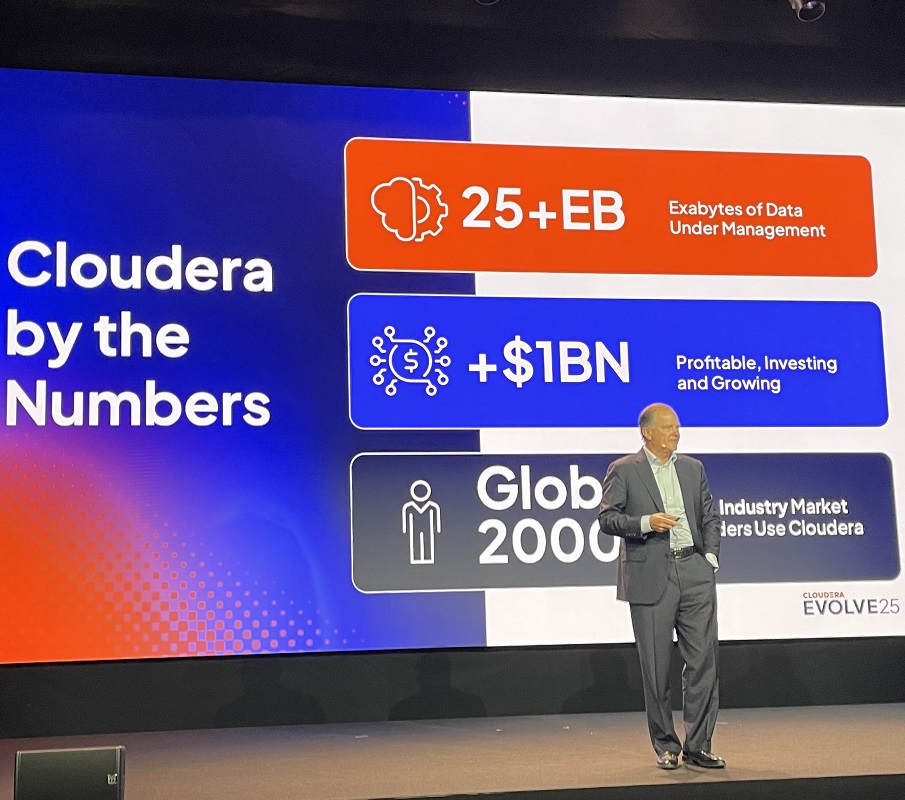
Charles Sansbury (pictured), CEO of global data and AI company Cloudera, took to the stage at their flagship EVOLVE event in New York.
The excited CEO is on a mission, and is absolutely nailing it.
For those living under a rock, Cloudera is the only data and AI platform company that large organizations trust to bring AI to their data, anywhere it lives. Unlike other providers, Cloudera delivers a consistent cloud experience that converges public clouds, data centers, and the edge, leveraging a proven open-source foundation.
Cloudera was founded in 2008 and has been a Big Data and analytics leader for over a decade, and with over 25 exabytes of data under management, on par with hyperscalers – it makes Cloudera the platform of choice for managing mission-critical enterprise data at scale.
As the pioneer in big data, Cloudera empowers businesses to apply AI and assert control over 100% of their data – in all forms. The world’s largest organizations across all industries rely on Cloudera to transform decision-making and ultimately boost bottom lines.
Cloudera’s clients include 8 out of the top 10 global banks, 8 out of the top 10 global automakers, and 9 out of the top 10 global telcos. And that’s just to name but a few.
On top of all those achievements, in 2024 Cloudera passed the $1 billion in annual revenue mark, and in 2025 that figure is expected to hit $1.1 billion.
And it’s not just the company’s engaging CEO shouting out its praises.
International Data Corporation (IDC), the premier global provider of market intelligence and advisory services, this month recognized Cloudera as a Leader in the Asia Pacific MarketScape for Unified AI Platforms. It’s quite an achievement when other companies in this top tier of leaders include the likes of Google, Microsoft, AWS, IBM and Oracle.
Before taking center-stage and showing off the sheer ‘epic-ness’ of Cloudera, Charles Sansbury outlined how he and his dynamic team plan are putting the customers’ needs and wants, first and foremost.
Sansbury – and Cloudera as a whole – have got to where they are by listening to their customers and adapting to their needs, rather than building products and providing services that hopefully customers will want.
“Cloudera founded big data and analytics, and became the data platform for the largest companies in the world – the most massive data sets, the most complex use cases – and that’s a great foundation,” Sansbury began.
“But then you saw the emergence of the cloud service providers and the cloud native software providers, and they provide a little bit more convenience than we do – easy to spin up, easy to get working, but they have issues with respect to cost of ownership, and specifically at scale, and then you have issues on security and data sovereignty.
“What we have been hearing from customers is that the end state data architecture, for a large global corporation, is going to be hybrid in nature. And with that we’re going to have some workloads that run on hardware that we own, we’re going to have private clouds, and we’re going to use the public cloud too, as it’s still very important.
“But if during this cloud rush that happened over the last two or three years, if we thought during that time that all of our workloads would end up on cloud, well, that is just not going to happen. Instead, 40% of our workloads will end up on hardware that we own – whether that’s on premises or private cloud – and 60% – the current estimate – will end up on cloud-based infrastructure. So customers are now rethinking what that means, which is increasing the importance of observability of an orchestration layer. But they have experienced with Cloudera the scalability, the complexity of the ability to have the software tackle big business problems, but that also came with complexity of implementation.
“We were not the easiest product to use. But the capability was amazing. And then you had the ease of use and the convenience that cloud service providers delivered. What we’ve been doing from an internal R&D – and also from an acquisition perspective – is to create a situation where customers aren’t forced to make that choice. So we started to deliver more ease of use and ease of deployment, and better user experience across our on premises, private cloud and public cloud-based capabilities. With that, customers can have both the capability and control they want with Cloudera, but with more convenience, ease of use and ease of upgrade that they’d expect from a cloud-native implementation.
“On the control and functionality side, we’ve done a couple of acquisitions, the most recent being a company called Octopai.”
Cloudera acquired Octopai in November 2024, whose data lineage and catalog platform enables organizations to understand and govern their data.
Cloudera’s most recent acquisition was that of Taikun in August 2025.
Sansbury continued, “The acquisition of Taikun – after six months of very detailed technical diligence – allows us to containerize the data platform and then also separate and containerize the data services – Cloudera Data Warehouse, Cloudera AI and Cloudera Data Flow – so that you no longer have – both from a sales and implementation perspective – a monolithic product, but also from an upgrade evolution perspective, we don’t have to upgrade that monolith to deliver additional functionality to customers. And then that containerized architecture allows us to deliver much better and more flexible user experience.”
“What you’ll see in just a couple of months, is this evolution of the product set so that we want to be the provider that doesn’t force you to make trade-offs between usability and scalability, control and cost. And this containerized architecture and then the evolution of our data services products are really impactful in doing that, and we are already rolling out the technology in front of customers – it’s what the largest customers in the world have told us they’ve wanted, and so that’s we’re delivering.
“What that allows us to be is that orchestration layer across the very large company’s data estates, giving them the power to do the analytics they want, and the flexibility to incorporate other repositories, other cloud service providers. That to us – being driven by what our customers tell us – is a very strategically important piece of the data infrastructure. So that’s what’s been driving both our internal development, as well as our external research and development in the mergers, because we have really been doing research and development in the acquisition market to speed time to market, and that’s what’s been driving us. So the endpoint is allowing customers to have both the control, cost effectiveness, and scale that’s inherent in Cloudera, and also improved usability, ease of use and user experience. That means that we will be the core data platform for these large companies, for the foreseeable future. That’s what we’ve been building toward,” Sansbury ended.
When the Cloudera team – and everyone all the way up to the CEO – have the ingrained mindset to listen to their customers and deliver what those customers want, it’s a clear recipe for success. And that success for Cloudera is already here and will be for a long time into the future.